All writing
Will AI End Education?
A reflection on how Artificial Intelligence can support teachers' work without replacing human creativity, judgment, and responsibility.
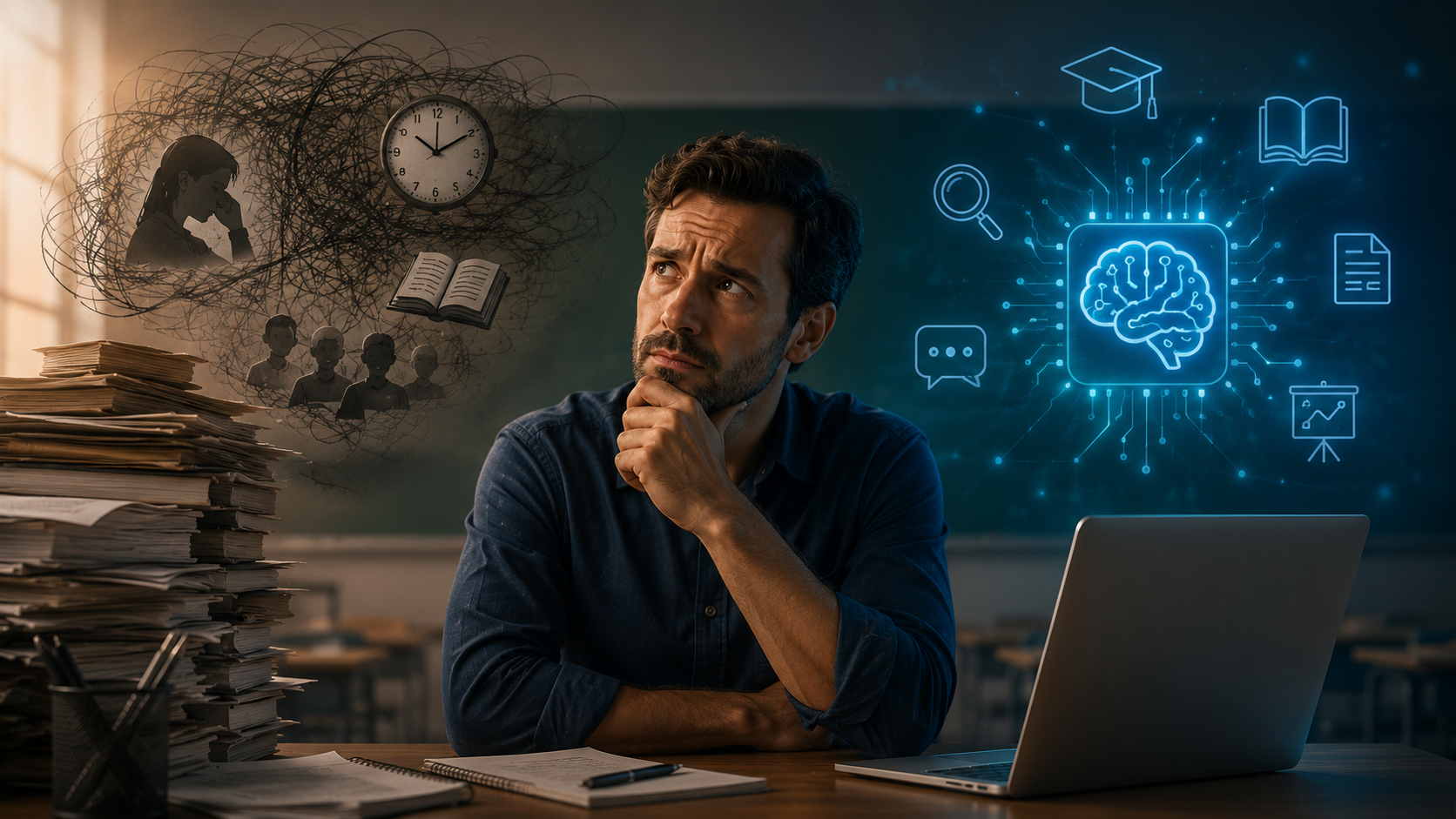
Education has never been static.
The way we teach and learn has changed many times throughout history, almost always alongside social and technological transformations. In the nineteenth century, teaching relied heavily on teachers’ oral explanations, memorization, and limited educational resources. Books were less accessible, information was scarce, and teachers held a central position as sources of knowledge.
In the twentieth century, this began to change rapidly. Books became more accessible, new audiovisual resources emerged, along with projectors and educational television, and computers eventually arrived in schools and universities.
Then came the Internet. Suddenly, knowledge that had once been concentrated in libraries became available just a few clicks away. Encyclopedias gave way to search engines. Scientific articles began circulating digitally. Videos, forums, virtual learning environments, and educational platforms once again changed our relationship with knowledge.
I am certain that each of these transformations met resistance. Someone probably believed that certain resources would make students lazy. That computers would harm learning. That searching the Internet was not really studying. That watching a recorded class could never contribute to someone’s education. Today, however, we use many of these technologies naturally.
Then came Artificial Intelligence. And history seems to be repeating itself.
Why are we demonizing AI?
I have watched with concern as one argument becomes increasingly common in educational settings: that Artificial Intelligence is a threat to teaching. There are clearly problems. A student can use AI to complete an assignment without even understanding what they are submitting. They can outsource their reasoning. They can produce work that does not represent what they have learned. They can receive incorrect information and accept it without any critical analysis.
But does that mean we should fight the technology? I do not believe so.
Like any tool, AI requires awareness of how, when, and why it should be used. The problem is not simply using AI. It is giving up intellectual autonomy and using it without reflection, validation, or responsibility. That is why I believe far more in teaching our students to use Artificial Intelligence in a human, ethical, and critical way than in simply trying to ban it. I believe the same principle should apply to us as teachers.
There is another side to this discussion: the teacher
When we discuss AI in education, we usually ask, “Can students use it?”
Perhaps that question is far too narrow.
We should also ask, “How can AI improve teachers’ work?”
This question becomes even more important when we consider the reality of education in Brazil. Teachers are profoundly undervalued professionals. Beyond classroom instruction, there is an enormous amount of work that remains invisible when we enter a classroom: planning, preparing materials, creating and grading assignments, filling out systems, entering grades, writing reports, attending meetings, assisting students, and handling countless other administrative demands. Much of that work follows teachers home.
There is another dimension as well. Increasingly, teachers are called upon to deal with problems that go beyond their training and professional role. Family problems, financial difficulties, personal conflicts, emotional distress, and different situations of vulnerability arrive at educational institutions every day.
This does not mean that we should abandon empathy. Quite the opposite. We need to see students as human beings. We need to listen, provide support, and refer them to the appropriate help when necessary. Human connection is an important part of education. But there is a difference between being humane and taking on responsibilities for which a teacher has not been trained.
A teacher teaches.
Teachers should not have to be, all at once, teachers, psychologists, social workers, and the people responsible for solving their students’ personal and financial problems. Schools, supported by the state, need to provide the mechanisms and specialized professionals required for that work. When we demand that teachers solve everything, something is inevitably left behind. Often, it is the teacher.
What if AI could give teachers their time back?
This is precisely where I see one of the greatest opportunities for Artificial Intelligence in education. A vast number of teaching tasks involve repetitive, operational, or bureaucratic work:
- Preparing the initial structure of a lesson plan;
- Generating a first draft of an activity;
- Creating questions from content that has already been defined;
- Organizing topics for a presentation;
- Adapting material for different levels of knowledge;
- Creating examples;
- Reviewing texts;
- Organizing information;
- Preparing initial drafts of documents.
Why should a teacher spend hours manually performing tasks that a machine can complete in seconds?
This does not mean handing responsibility over to AI. The distinction is fundamental.
AI can generate. The teacher evaluates. AI can suggest. The teacher decides.
AI can produce a first draft. The teacher reviews, modifies, contextualizes, and takes responsibility for the result. This is how I try to view this technology in my own work as a teacher and researcher: not as a substitute for teachers, but as a tool that supports their work.
Teachers should not be content-producing machines
There is an interesting contradiction in this discussion. We fear that machines will replace teachers, yet we have long treated teachers like machines:
- Machines for preparing slides;
- Machines for grading assignments;
- Machines for filling out systems;
- Machines for producing documents;
- Machines for answering messages;
- Machines for handling bureaucracy.
After all of that, we expect the same professional to walk into the classroom rested, motivated, up to date, creative, and ready to provide an excellent learning experience.
Perhaps we are looking at the problem from the wrong side. Artificial Intelligence does not have to remove humanity from education. It may actually help restore it. If a tool allows me to reduce a two-hour bureaucratic task to twenty minutes, the other one hundred minutes do not have to be used to produce even more.
They can be used to prepare a better lesson:
- To study;
- To conduct research;
- To talk with students;
- To think of a different activity; or
- Simply to rest.
Because caring about the quality of education also means caring for those who teach.
Humans create. Machines execute.
I do not believe in an education system in which Artificial Intelligence replaces teachers. Nor do I believe in one that simply pretends Artificial Intelligence does not exist.
I believe in a third possibility:
- The teacher defines the objectives;
- The teacher knows their students;
- The teacher understands the context;
- The teacher chooses the methodology;
- The teacher evaluates what makes sense;
- The teacher validates the result.
AI works within those boundaries.
This requires a skill that will probably become increasingly important: knowing what to delegate to a machine and what should never be delegated.
Creativity, judgment, responsibility, empathy, experience, and an understanding of context remain essentially human. The execution of certain tasks can be shared with technology.
Perhaps, then, the question is not whether teachers should use Artificial Intelligence. The question should be:
How can we use it to become better teachers without letting it think for us?
Education has already undergone many technological revolutions. This is just one more. In my view, we do not need to fight it. We need to learn how to use it to our advantage.
In the end, the idea is quite simple:
Humans keep the creativity; AI helps with execution.
And the time we recover can be devoted to what truly matters: teaching better and remaining human while we do it.